
Omicron Chronicles
Masimba Musodza · Zimbabwe / UK
“You’re joking,” Dr. Murape said, staring at the live feed from Cape Town. The man on screen kept talking, his lips moving in silence before the audio finally synced. She caught the tail end: “…protocols were approved yesterday.”
Her office walls, lined with thin sheets of lunar aluminum, vibrated faintly. The recycled air carried a metallic tang. Outside her window, Earth hung low.
The man was still talking. She muted him. Across the room, her assistant, Tariro, exhaled sharply through his nose. “You knew this would happen eventually,” he said. His fingers tapped at the holoscreen between them, pulling up skeletal diagrams.
Dr. Murape reached out and halted the diagrams’ lazy spin with one finger, freezing them on a human spine annotated in crimson where the modifications would go. Something beneath her ribs cinched tight. “Eventually isn’t supposed to be today,” she said.
More Omicron Chronicles


Tariro leaned in, his reflection warping across the holoscreen. “They’ve moved up the timeline because of the summit. The East Asian delegates want proof we can reverse lunar osteoporosis before they sign the trade pact.” His breath smelled faintly of ginger, sharp against the sterile air.
Outside, a freight rover rumbled past, its treads kicking up moondust. Murape watched a single grain land and stick—static cling from the colony’s low humidity. She flexed her own fingers, imagining the way Earth’s gravity would pull at them. “Who did they assign?”
Tariro didn’t meet her eyes. “Ambuya Chiguma. They’re prepping her in Medbay Three right now.” When Murape didn’t move, he added, more quietly, “She asked for you.” The words hung there, heavier than anything on the moon should be.
Murape stood abruptly, her chair scraping against the polymer floor. Through the window, Earth’s glow painted sharp shadows across her cheekbones. Ninety-six years old. The numbers clanged in her head: ninety years of calcified lunar bones, ninety years since those feet last touched dirt. She had grown up watching holos of Ambuya Chiguma’s childhood in Zimbabwe, hearing the way she spoke about mango trees with a reverence usually reserved for saints.
◆
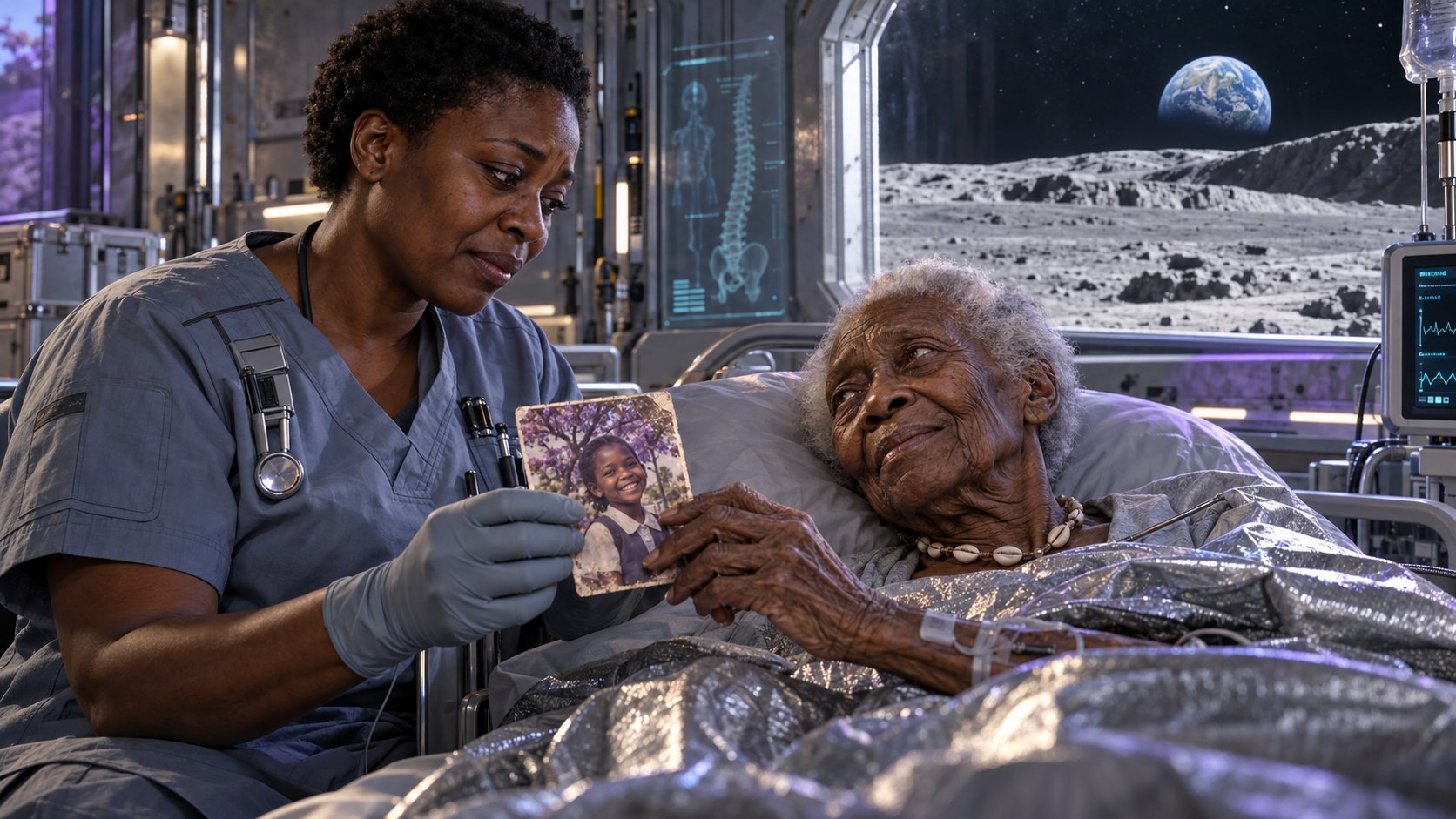
Medbay Three smelled different—not just antiseptic, but laced with the earthy musk of fermented milk from the sponsorship banners draped above the surgical pod. Ambuya Chiguma lay cocooned in silver thermoregulation sheets, her hands folded over pamphlets advertising Inyambo Milk (“Strong Bones for Lunar Generations”). Her eyes opened when Murape approached, dark and laughing despite the tubes taped to her arms. “Ah, mwanangu,” she rasped. “Tell me—will I finally taste maheu again?”
Something sharp pressed against Murape’s ribcage: the memory of her own first sip of that fermented millet drink at twelve, during training on Earth. She reached for Ambuya Chiguma’s chart instead of answering. The bone density scans glared back, a topography of craters worse than the moon’s.
Ambuya Chiguma’s fingers, curled like old roots, tapped the IV line feeding her forearm. “Don’t look so frightened,” she said. Above them, a holo-ad shimmered to life: Inyambo cattle grazing under Earthlike UV lamps, their giant horns polished for the cameras. The jingle, “From Lunar Grass to Galactic Class!”, buzzed against Murape’s molars.
Through the observation glass, technicians in biohazard suits moved like slow-motion astronauts, calibrating the gravity treadmill that would—theoretically—reteach Ambuya Chiguma’s muscles Earth’s cruel arithmetic. One dropped a wrench; it floated downward, taking its time. Murape counted the seconds. Too long.
Ambuya Chiguma chuckled wetly. “I dreamed last night,” she whispered. “The jacarandas at Avondale. Purple rain, hay fever.” Her wrist monitor chirped—heart rate spiking—but her eyes stayed fixed on Murape’s. “They’ll hold the reunion under those trees, yes? Even if I come back… changed?” The word hung between them, twisting.
Murape’s thumb hovered over the sedation button. Through the glass, she caught Tariro mouthing “Thirty minutes” until launch prep. The dairy company’s logo pulsed on the ceiling—a cow leaping over a crescent moon—casting long shadows across Ambuya Chiguma’s sunken cheeks. “They’re waiting,” Murape lied, and pretended not to notice when Ambuya Chiguma’s fingers crept toward the tray of ceremonial Inyambo steak, cold and gleaming under the lights.
◆
The first convulsion came just as the countdown reached T-minus fifteen. Ambuya’s body arched, her necklace of terrestrial seashells scattering across the floor like brittle stars. Alarms shrieked; Murape tasted copper where she had bitten her tongue. Above them, the holo-ad flickered to a looping message: Inyambo—Building Strong Africans Across Two Worlds.
Tariro was shouting something about airway obstruction when Murape finally registered the half-chewed mass wedged in Ambuya Chiguma’s throat—not meat, but a crumpled photograph slick with saliva. The edges showed a fragment of school uniforms, a blurred face under jacaranda blooms. Murape’s gloves slipped on the woman’s dentures as she reached in. Somewhere below them, Earth turned.
Two technicians yanked the gravity treadmill’s harness loose, its buckles clanging against the surgical pod. The dairy sponsorship banner tore under someone’s elbow, revealing the original colony wall beneath, pockmarked with old emergency patches like scar tissue. Ambuya Chiguma’s cardiac monitor flatlined just as Murape’s fingers closed around the photo. When the alarms cut out, the silence hit like decompression.
Later, while the corporate reps argued over whether to airlock the body or ship it frozen for terrestrial burial, Murape would notice the milk stain on her sleeve. It smelled nothing like Earth. The seashells crunched underfoot as she walked to the viewport where Jupiter was rising, its storm eye staring back. Tariro found her there, holding the damp photograph up to the glass like a child’s telescope.
Behind them, the colony’s PA system crackled to life with the Inyambo jingle before someone hastily killed it. The abrupt quiet left room for Murape to hear it—the sound of her own lunar-adapted bones settling, like creaking floorboards in a house she had forgotten was haunted. Outside, moondust swirled against the reinforced glass, sticking wherever static clung.

Ómicron Books · Store
La mujer del mar y otros relatos
If stories where the everyday brushes against the fantastic move you, discover Coralía Córdova Saltos’s collection (in Spanish): women who vanish into the waves, letters from beyond and a love that memory won’t let go. Ebook in ePub and PDF.
The photograph trembled in Murape’s grip—not from the colony’s low gravity, but because her hands refused to steady. Up close, the image was worse: Ambuya Chiguma’s teenage grin, half torn away by teeth marks, the edges of the photo softened by decades of handling. Behind her, the jacaranda blossoms were a purple smear, the kind of color the moon had never seen. Tariro’s breath fogged the viewport beside her. “They’ll blame the dairy supplements,” he muttered. “Say her bones were too brittle for the gravity shift.”
Murape’s thumb traced the photo’s ragged edge. She could already hear the corporate spokesmen spinning it: “Tragic, but inevitable; the risks of long-term lunar habitation…” Never mind that Ambuya Chiguma had outlived three generations of their lab rats. Never mind that she had memorized the exact pressure needed to pop an Inyambo milk pouch open with her arthritic fingers. The monitors above the surgical pod still flashed PROCEDURE TERMINATED in cheerful green, as if it were just another completed task.
Behind them, the airlock hissed. A medic wheeled in a gurney draped with the company flag—a leaping cow stitched in gold thread. Murape folded the photograph into her palm before they could take it as evidence. “Her personal effects?” the medic asked, already reaching for the IV line. Murape watched Ambuya Chiguma’s wrist flop bonelessly off the gurney, the skin papery under the harsh LEDs. “Gone,” she lied.
Tariro’s elbow bumped hers as they stepped back. “You know they’ll autopsy her,” he whispered. “If they find out she choked on—”
“Then we make sure they don’t.” Murape pocketed the photo, feeling the outline of jacaranda petals through the fabric. The corporate reps were huddled outside Medbay Three, tablets glowing in their hands. One glanced up, his smile a perfect white crescent. “Doctor,” he called, too brightly. “A word about the, ah, incident?”
◆
The corporate rep stopped two paces away, careful not to wrinkle the sterile cuffs of his suit. Up close, Murape could see the dust caught in the seams of his boots like ash.
“A regrettable outcome,” he said softly. “But if we control the narrative early, the summit can still proceed on schedule.”
Behind him, the company flag shifted as the medics sealed Ambuya Chiguma’s body into transit polymer. The gold-threaded cow seemed to leap once, then disappeared beneath the folds.
Murape felt the photograph digging into her palm.
“She requested the procedure voluntarily,” the man continued. “We’ll emphasize dignity. Courage. The pioneering spirit of—”
“She tried to eat the evidence,” Murape said.
The rep blinked.
Tariro went very still beside her.
Murape unfolded the damp photograph carefully. The jacaranda blossoms had bled violet onto her gloves. “Ninety-six years,” she said. “And the last thing she put in her mouth wasn’t your supplements or your ceremonial meat.” Her voice sharpened. “It was home.”
The corridor hummed around them. Ventilation fans. Cooling pumps. The enormous mechanical heartbeat of the colony itself.
The rep’s expression hardened first. Then smoothed. “Doctor, grief can distort—”
“She knew,” Murape said. “She knew what your procedure would do to her.” She looked past him, through the viewport, toward the distant smear of Earth hanging over the crater rim. “You keep calling this adaptation. But adaptation to what?”
No one answered.
The colony lights dimmed briefly as another freight launch drew power from the grid. In the momentary half-dark, Murape became aware again of her own skeleton: the tiny, painless shifts in her hips, her spine, the quiet architecture the moon had built inside her. Bodies changed here. Not temporarily. Not cosmetically. Entire generations shaped by weaker gravity, sealed air and recycled water.
And Earth, waiting below them, still demanded they return unchanged.
The rep recovered first. “The summit begins in four hours,” he said. “We’ll need your statement before transmission.”
Murape looked at the photograph one last time. Then she slid it into Ambuya Chiguma’s folded hands before the medics could seal the shroud completely.
“Tell them,” she said, “the procedure failed.”
The rep exhaled in visible relief.
Then Murape met his eyes.
“And tell them,” she continued, “we’re done trying to make the moon apologize for what it’s made of us.”
Outside the viewport, moondust lifted in slow silver spirals beneath the departing shuttle, rising high enough that, for a moment, it looked almost like purple blossoms falling against the dark.
◆ ◆ ◆
About the author
Masimba Musodza
Masimba Musodza (Zimbabwe, 1976) lives in Middlesbrough, in North East England. He has published two speculative fiction novels and a novella in ChiShona, his first language; the novella is now available in English as Aquilina (or, The Confession of Hatifari Maforimbo). He has published more than 40 short stories in anthologies and magazines such as Omenana, MetaStellar and Afrofuturism Short Stories, and was featured in Geoff Ryman’s 100 African Writers of Speculative Fiction. His latest book is Speaking for Melos. He also writes for film.
Ómicron Podcast
Listen to science fiction
Conversations (in Spanish) about science fiction, fantasy, culture and possible futures.
Ómicron School
Introduction to Science Fiction Course
Want to write your own story? Learn with our School of Science Fiction and Fantasy (in Spanish).
Do you write science fiction or fantasy? Submit your story to Omicron Chronicles →
Cover image: ChatGPT


Debe estar conectado para enviar un comentario.